
Hazardous Waste Disposal for Houston Businesses
Dimension collects hazardous waste from businesses across the Houston area — solvents and process chemicals from petrochemical and manufacturing operations, lab waste, contaminated absorbents and rags, waste oil, coolants and coatings. We handle the classification, the manifest and DOT-compliant transport, and every pickup closes with documentation you can file.
Houston is our strongest market outside California, with six providers servicing hazardous work here and the highest average order value of any metro we operate in. Industrial volumes are normal for us, and one-off project loads are as welcome as scheduled routes.
This is a business service. Households with hazardous waste should use the City of Houston or Harris County residential collection programs — we cannot collect from residential addresses.

Trusted by 10,000+ clients
Nationwide waste partner for Trek Bikes, Instacart, Sares Regis and more! Trusted by state governments of California, Texas and Connecticut.




Ready to get rid of your Houston?
Get an instant price quote powered by our Mirror Mirror AI. Most orders are priced in minutes.
Get an Instant QuoteProudly Serving






Public Sector
How Texas regulates your waste differently
Regulated by Texas Commission on Environmental Quality (TCEQ) — Region 12, Houston, covering Harris County
Texas does not use the local-agency model that California and many other states do. There is no county CUPA to permit you; registration and reporting go to TCEQ directly, through its Industrial and Hazardous Waste program. The regional office covering Harris County is TCEQ Region 12 in Houston, at 5425 Polk Avenue, Suite H.
Texas also recognizes a waste class that has no federal equivalent: Class 1 industrial waste. A material can be non-hazardous under federal RCRA rules and still be Class 1 in Texas, which brings its own registration, manifesting and reporting obligations. Latex paint, certain sludges and many process residues land here. Businesses moving to Houston from another state are often surprised by this, because the waste itself has not changed — the classification has.
The one place Texas is more forgiving than California: there is a genuine low-volume floor. An unregistered facility generating less than 220 pounds of hazardous or Class 1 industrial waste per month, and less than 2.2 pounds of acutely hazardous waste, does not have to notify or report to TCEQ. California has no equivalent exemption at all. If you are near that line, it is worth knowing exactly which side you are on before you assume either way.
Above the floor, obligations scale. A small quantity generator producing 100 to 1,000 kilograms a month needs a Texas or EPA generator ID obtained through myRCRAid, keeps waste no longer than 270 days, labels containers, names an emergency coordinator, trains staff, ships on a manifest with a TCEQ-registered transporter, files a biennial report and pays an annual TCEQ fee. Above 1,000 kilograms a month the accumulation limit drops to 90 days and a full contingency plan and annual waste-minimization certification are added.
| Requirement | What it means for your business |
|---|---|
| Under 220 lb per month | An unregistered facility below 220 pounds of hazardous or Class 1 waste, and 2.2 pounds of acutely hazardous waste, need not notify or report to TCEQ. Worth confirming rather than assuming — the floor is per month, not per shipment. |
| Texas or EPA generator ID | Obtained through myRCRAid once you are above the floor. Required before waste can move off site on a manifest. |
| Class 1 industrial waste | A Texas-only category with no federal equivalent. Material that is non-hazardous under RCRA can still be Class 1 here and carry registration and reporting duties. We classify before pickup. |
| A TCEQ-registered transporter | Manifested shipments must move with a transporter registered in Texas. Ask any provider to confirm registration before they collect. |
| Accumulation limits and annual reporting | 270 days for small quantity generators, 90 days above 1,000 kg per month. Registered generators file an Annual Waste Summary; administrative changes go on form TCEQ-00002. |
Rules change — confirm current requirements with the agency before relying on this page.
Areas we serve around Houston
We collect across greater Houston — the Ship Channel and Pasadena industrial corridor, the refining and petrochemical belt through Deer Park and Baytown, the Energy Corridor and west-side commercial parks, and manufacturing and distribution sites north toward The Woodlands and Conroe. Houston has our highest average order value of any metro, and large single-site industrial loads are routine here.
- Harris County
- Fort Bend County
- Montgomery County
- Galveston County
- Brazoria County
- Chambers County
Case Studies
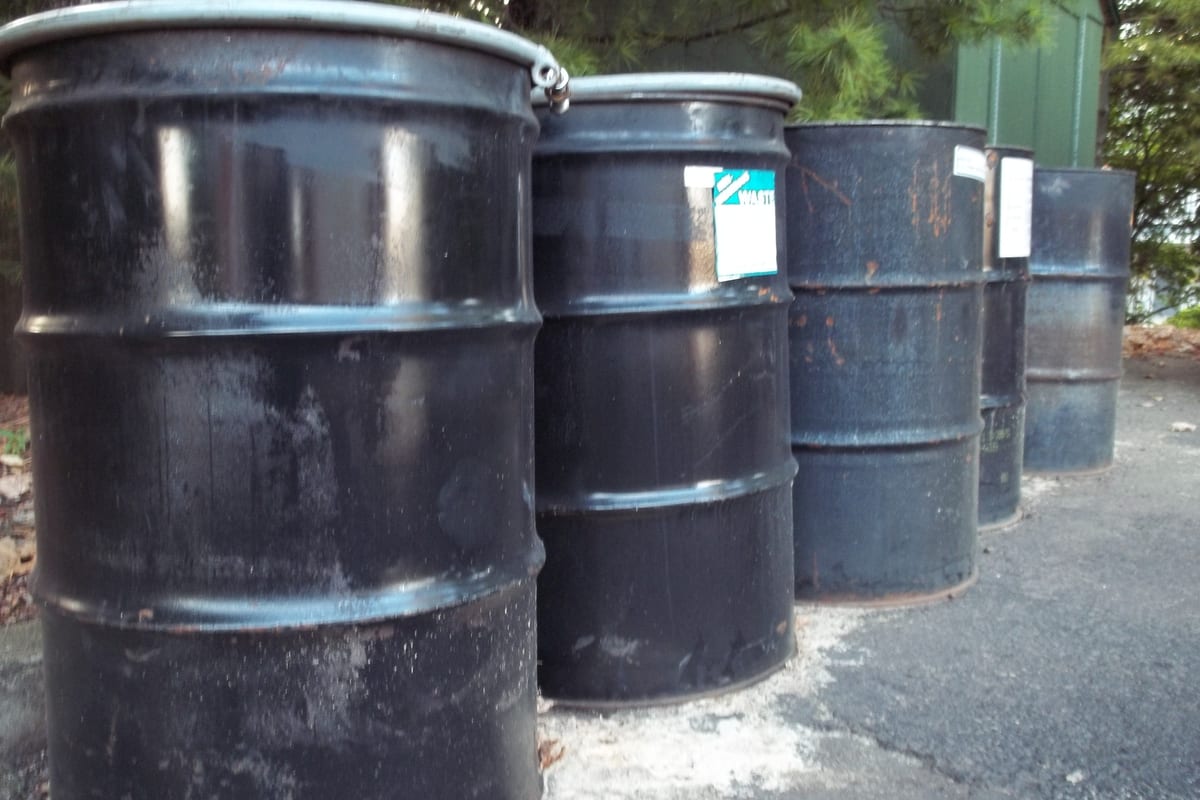
A large furniture manufacturer came to Dimension with the problem this page exists to solve: not one waste stream, but several at once. Oil-based paints from the finishing line, used motor oil from the maintenance shop, and an assortment of other chemicals that each needed specialized handling — and no straightforward, compliant way to get rid of any of it. Getting it wrong risked regulatory penalties, environmental damage, and real health risks to their employees and the surrounding community.
Dimension took the whole mix. A dedicated account manager scheduled each service inside a narrow time window so nothing accumulated past its limit on site, trained professionals transported the material to a licensed, EPA-approved disposal facility in line with every applicable transportation regulation, and Dimension managed the documentation end to end — manifests and certificates of disposal covering city, state and federal requirements. A customized pricing scheme brought the total cost down at the same time.
That is the shape of a hazardous-waste program done properly, and it is what a single booking on this page starts: the classification handled with you, every stream routed to a facility permitted to take it, and the paperwork back in your hands afterward.

What Hazardous Waste Disposal With Dimension Looks Like
- Quote and schedule: Describe your waste in plain language — the materials, rough quantities, and container sizes, anywhere from 1-gallon cans and 5-gallon pails to 55-gallon drums and 550-gallon totes. You can attach photos of the labels if you're unsure. Most orders are priced instantly by our AI; mixed, unlabeled, or high-volume loads go to our team for a manual quote within one business day. Plan on about five business days of lead time for the pickup.
- Compliant transport: A provider from our nationwide network of DOT- and RCRA-trained, EPA-certified transportation partners arrives on site, verifies and loads the material, and applies the correct DOT labels, placards, and shipping papers for each stream. We serve every zip code in the country except New Jersey, from 8 AM to 8 PM local time, and can put recurring pickups on a set schedule if your waste accumulates on a predictable cadence.
- Documented disposal: Each stream goes to a licensed facility approved for that material — solvents recovered, oils re-refined, metals reclaimed where the material allows, and the rest destroyed under permit. You get the records back: hazardous waste manifests, Bills of Lading, and a diversion report showing what happened to each stream, so your compliance file is complete without you chasing anyone for paperwork.
Houston questions, answered
Do I need to register with TCEQ or with a county agency?
With TCEQ. Texas does not use the local CUPA model that California does — there is no county permit to obtain. Registration and reporting run through TCEQ’s Industrial and Hazardous Waste program, and the regional office for Harris County is TCEQ Region 12 in Houston.
That also means a company with sites in Houston and Dallas deals with one state agency, not two local ones — simpler than the California picture.
What is Class 1 industrial waste?
A Texas classification with no federal equivalent. A waste can be non-hazardous under federal RCRA rules and still be Class 1 in Texas, which brings registration, manifesting and reporting obligations of its own.
Latex paint, various sludges and many process residues commonly fall here. If you moved operations to Texas from elsewhere, the waste has not changed but its classification may have. Describe what you generate and we will classify it as part of the quote.
Is there a volume below which I can skip all of this?
Yes, unlike California. An unregistered facility generating under 220 pounds of hazardous or Class 1 industrial waste a month, and under 2.2 pounds of acutely hazardous waste, does not have to notify or report to TCEQ.
The threshold is monthly, not per shipment, and it is measured across everything you generate. Businesses close to the line should establish where they sit deliberately rather than by assumption.
How long can I store waste before it has to move?
A small quantity generator producing 100 to 1,000 kilograms a month may accumulate for up to 270 days. Above 1,000 kilograms a month that drops to 90 days, and a full contingency plan and annual waste-minimization certification are required.
We schedule around those windows rather than against them — tell us your generator status and we will work back from your accumulation deadline.
Can you handle large industrial volumes?
Yes, and Houston is where we do most of it. This metro produces our largest single-site orders, and six providers service hazardous work here.
Very large or unusual loads route to a human quote within one business day rather than being priced instantly, so the facility match is right before anything is scheduled.
Serving a business outside Houston? See our nationwide hazardous waste disposal.